
If you had a C-section, I want to start with something that gets skipped a lot: you had major surgery. Cleveland Clinic says it just that plainly: "A C-section is major surgery." And then, instead of resting the way anyone else would after surgery, you went home and were handed a newborn to lift, feed and rock at 3 a.m.
Whether your C-section was a few months ago or twelve years ago, this one is for you. Your kids might be teenagers by now and your lower belly might still feel a little "off." That's worth paying attention to, and it's not too late to do something about it.
The short answer: Your core after a C-section (cesarean birth) can get strong, whether your surgery was recent or years ago. A C-section is major surgery through several layers of your abdomen, so your surgeon's timeline comes first. Then reconnect gently, starting with your breath, and build strength gradually. If your lower belly or scar still feels numb, tight or painful, bring it up with your doctor or a pelvic floor physical therapist.
A C-section goes through more than skin
To deliver your baby, the surgeon makes an incision through the skin and into the wall of the abdomen, and then into the uterus. After the birth, those layers are closed again. So the scar you can see is only the top of the story. Underneath it are several layers of tissue that were opened and repaired, and that kept changing long after the outside looked finished.
That matters for your core. The deep abdominal muscles and the connective tissue around them are part of the system that supports your trunk, moves with your breath and coordinates with your pelvic floor. When part of that system has been through surgery, it makes sense that it needs time and some patient retraining to feel like a team again.
Why does my lower belly feel numb or disconnected after a C-section?
After a C-section, your lower belly can feel numb, far away, or slow to respond when you try to use it. A few things can play into that:
- Changes in sensation. One NHS hospital leaflet on scar care explains that your scar may feel sensitive or tender, or you may have less sensation or even numbness in some areas.
- Scar tissue. As the area recovers, scar tissue forms. Sometimes there's enough of it to leave the scar feeling tight, sore, or like it pulls and tugs when you move.
- Protecting the area. After surgery, guarding is very human. You stood up slowly, coughed holding a pillow, and avoided anything that made your belly work. That was smart at the time. Sometimes the habit of not using the area simply stays.
- Pregnancy itself. Your abdominal wall stretched for months before your baby arrived, no matter how they arrived.
For some women, numbness and discomfort around the incision linger. In a Dutch study that surveyed women about two years after this kind of low abdominal incision, numbness was one of the factors linked to ongoing pain at the scar. If you still have pain at your scar, that's a conversation for your doctor, whenever your surgery was.
Now the part I want every mom to hear. Feeling disconnected from your core happens after vaginal births too. The type of birth changes your starting point. It doesn't decide whether you can get strong.
When can I exercise after a C-section?
In the early weeks, the guidance from reputable sources is pretty consistent. The NHS says you can hold and carry your baby but may not be able to lift anything heavier than your baby straight away, that a gentle daily walk is a good idea, and that you should only go back to activities like exercise when you feel able and they aren't uncomfortable, which may not be for 6 weeks or so. Cleveland Clinic notes that most providers recommend limiting lifting and avoiding exercise and strenuous activity for several weeks.
Your surgeon knows things about your surgery that no article does, so their guidance comes first. Ask them directly about lifting, exercise and your scar. And remember that being cleared at your postpartum visit means you're allowed to start, not that you're expected to jump straight back into everything. Recovery is individual.
Reconnecting starts with your breath
My one anatomy concept for today: your diaphragm and your pelvic floor move together. When you breathe in, both gently descend and your belly and ribs expand. When you breathe out, both gently rise and your deep abdominal muscles draw in a little. That rhythm is the foundation everything else is built on, and it's often the first place moms can feel their lower belly again.
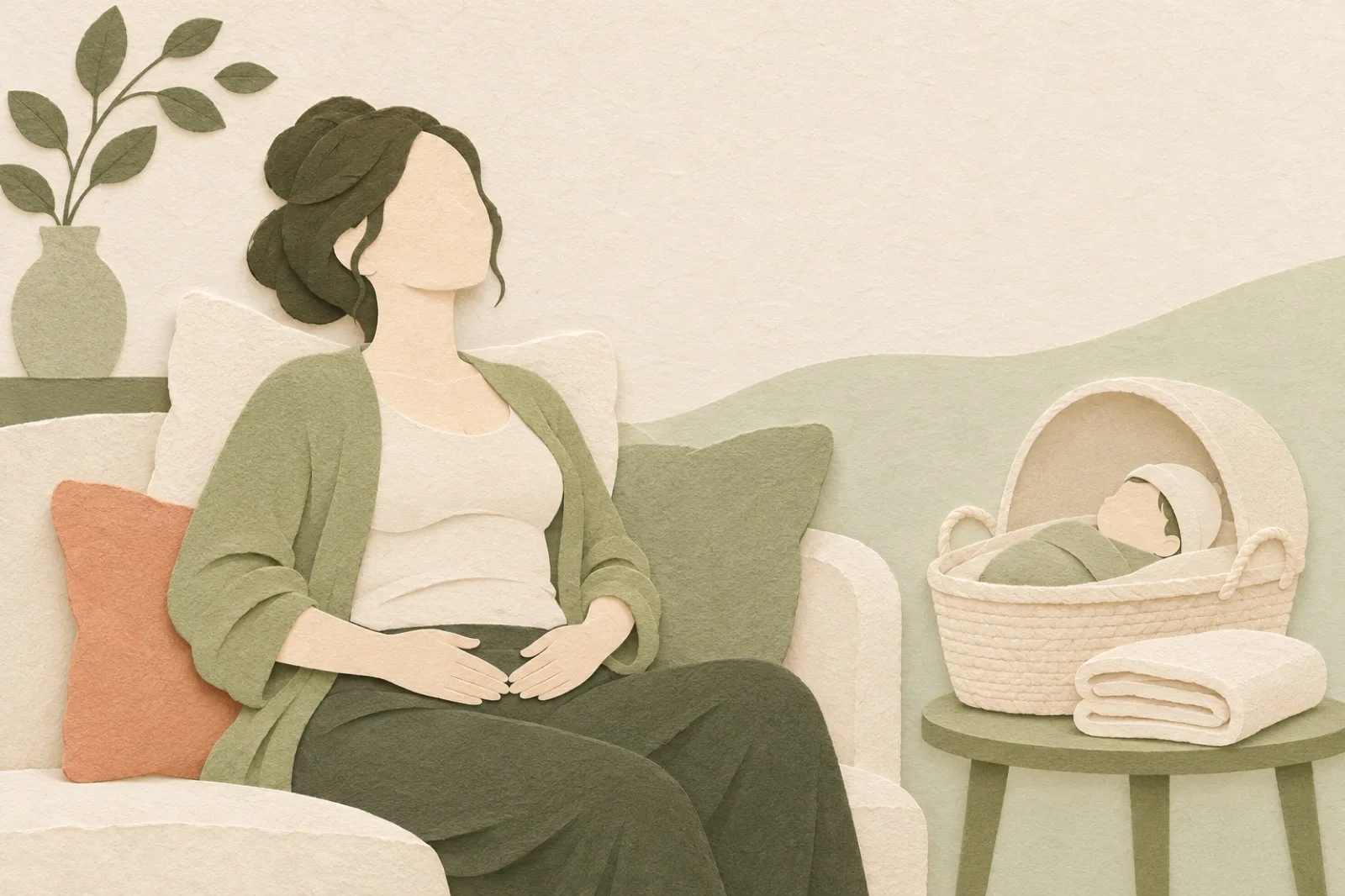
Try this: If your C-section was recent, check with your doctor before you practice this. Then lie on your back with your knees bent, or sit comfortably. Rest one hand on your lower ribs and the other lightly on your lower belly, over your clothes and above your scar. Breathe in through your nose and let your ribs widen and your belly soften into your hand. Breathe out slowly through pursed lips and notice a gentle lift of your pelvic floor and a light draw-in of your lower belly, away from your hand. Do 5 slow breaths. If you can't feel much yet, that's information, not failure.
If anything in this practice causes pain, or you notice leaking that gets worse, a feeling of heaviness or bulging in the vagina, or bleeding, stop and talk to your doctor or a pelvic floor physical therapist.
Should I massage my C-section scar?
You may hear about scar desensitization or mobilization, meaning gradually getting the area used to touch and helping the tissue move more freely. Some moms find it makes the scar more comfortable. The NHS leaflet I read is honest that not much research has been done on how well it works. One NHS leaflet describes scar massage as something your provider may suggest once the wound has fully closed, usually around 6 to 8 weeks after birth, and warns that starting too soon could make it reopen.
I'm not going to teach a technique here, on purpose. Once your doctor clears it, a pelvic floor physical therapist can assess your scar and show you what's right for you. If your C-section was years ago and your scar still feels tight, numb or tender, it's still worth bringing up.
Building strength, gradually (and the signs to call your doctor)
Foundation before load. Once breathing and that gentle lower-belly connection feel familiar, strength comes in layers: gentle core work, then real-life patterns like squatting, getting up from the floor and carrying, then more load as your body shows it's ready. No rushing to the hardest version. Your core after a C-section can get strong. It just deserves a smart progression.
Your surgeon and your physical therapist lead this part. My work starts once they've cleared you.
If your C-section was recent, call your doctor right away if you notice:
- Fever, chills or feeling generally unwell
- Redness, swelling or heat around the incision
- Discharge, pus or a bad smell from the wound
- The wound starting to open
- Pain that gets worse instead of better
- Heavy bleeding
- Pain or swelling in your lower leg
Call 911 if you have chest pain, trouble breathing or shortness of breath, a seizure, or thoughts of hurting yourself or your baby. Those can't wait for a callback.
Key takeaways
- A C-section is major surgery that goes through the skin, the wall of the abdomen and the uterus, so the scar you can see is only the top layer.
- A numb, tight or far-away feeling in the lower belly after a C-section can come from changes in sensation, scar tissue, guarding and pregnancy itself.
- Your surgeon's guidance on lifting and exercise comes first, and being cleared means you're allowed to start, not that you're expected to jump straight back into everything.
- Reconnecting often starts with your breath, because your diaphragm and pelvic floor move together, and strength is then built in layers.
- If your C-section was recent, call your doctor right away for fever, wound redness or discharge, worsening pain, heavy bleeding or lower-leg pain, and call 911 for chest pain or trouble breathing.
Frequently asked questions
Is it too late to work on my core years after a C-section?
No, it's not too late to reconnect with your lower belly and build strength gradually. Start with your breath, then add gentle core work and real-life patterns like squatting and carrying. Get medical clearance first, and if your scar still feels tight, numb or tender, bring it up with your doctor or a pelvic floor physical therapist.
Why is my C-section scar still numb or tight years later?
Numbness and tightness around a C-section scar can linger for some women. An NHS hospital leaflet explains that a scar may feel sensitive or tender, or have less sensation or numbness in some areas, and that scar tissue can leave it feeling tight or sore. In one study, numbness was linked to ongoing pain at the scar. If your scar is still numb or painful, talk to your doctor.
How soon can I lift things after a C-section?
Your surgeon's guidance comes first. The NHS says you can hold and carry your baby but may not be able to lift anything heavier than your baby straight away, and Cleveland Clinic notes that most providers recommend limiting lifting for several weeks. Ask your surgeon directly about lifting, and call your doctor if you notice worsening pain, heavy bleeding or changes in your wound.
Is breathing a good first step to reconnect my core after a C-section?
For many moms, yes. Your diaphragm and pelvic floor move together, and gentle breathing is often the first place moms can feel their lower belly again. Lying on your back or sitting, rest one hand on your lower ribs and one above your scar, and breathe slowly. If your C-section was recent, check with your doctor first, and stop if you feel pain, heaviness or bleeding.
If you'd like support building strength from your core at your own pace, you can read how ReConnect Mom works. Take your time with it. Your body has already done something big.
My work is fitness coaching and does not replace medical or physical therapy care. Medical clearance from your doctor is required before starting. Individual results vary.
References
- Cleveland Clinic — C-Section. https://my.clevelandclinic.org/health/procedures/7246-cesarean-birth-c-section
- NHS — Caesarean section: Recovery. https://www.nhs.uk/tests-and-treatments/caesarean-section/recovery/
- Gloucestershire Hospitals NHS Foundation Trust — Caesarean section wound care. https://www.gloshospitals.nhs.uk/your-visit/patient-information-leaflets/caesarean-section-wound-care/
- Kingston and Richmond NHS Foundation Trust — Scar massage after caesarean birth. https://www.kingstonandrichmond.nhs.uk/patients-and-families/patient-leaflets/scar-massage-after-caesarean
- Loos MJ, Scheltinga MR, Mulders LG, Roumen RM — The Pfannenstiel incision as a source of chronic pain (Obstetrics & Gynecology, 2008). https://pubmed.ncbi.nlm.nih.gov/18378742/