You know the reflex. You get the green light to exercise, you want your belly to feel strong again, and you reach for what we all learned in gym class: crunches, sit-ups, a plank held until you shake.
I get it. Those moves feel like "core." They burn, so they must be working, right?
Let me be honest from the start, because this topic gets oversimplified in both directions. Crunches are not evil, and they're not forbidden forever. But for most moms they're usually not the first step. Here's why, and what I'd rather see you start with.
The short answer: Crunches after pregnancy aren't bad, and they aren't forbidden forever, but for most moms they're usually not the first step. Research shows curl-ups can build abdominal strength, yet how you do them may matter as much as which move you pick. I'd start with breath, alignment and pressure management, after medical clearance and ideally an assessment with a pelvic floor physical therapist.
Are crunches bad after pregnancy?
If you've heard that crunches will "make your separation worse," the research is more complicated than that.
Ultrasound studies have looked at what happens at the midline during a crunch, and found that the gap between the two sides of the six-pack muscle actually gets narrower in the moment. In a 2023 randomized trial, women with abdominal separation (diastasis recti) 6 to 12 months after birth did a 12-week home program that included head lifts and curl-ups. Their abdominal strength and muscle thickness improved, and their separation neither narrowed nor got worse.
So "never do a crunch again" isn't what the evidence says.
But here's the other side. Another study found that when women with separation curled up on autopilot, the gap narrowed, yet the tissue at the midline sagged and distorted more. When they gently engaged their deepest abdominal muscle first, the tissue stayed more taut. In other words, how you do the movement may matter as much as which movement it is. And the authors of the 2019 return-to-running guideline say plainly that the evidence on returning to exercise after birth is still limited.
Some health sources take a stricter line. Cleveland Clinic, for example, advises against crunches and sit-ups when there is separation, against planks unless they're modified, and against anything that makes your belly bulge, dome or cone.
Put together, the honest answer is: it depends. It depends on your body, on how far along you are, and especially on how well your core manages pressure right now.
Why foundation comes before load
Here's how I explain it in plain language. Your core isn't one muscle. It's a team: the diaphragm on top, the pelvic floor underneath, and the deep abdominal muscles wrapping around the middle. Every time you lift, cough, laugh or crunch, the pressure inside your belly goes up, and that team has to meet it.
When all the parts work together, they share that pressure. When they don't coordinate well yet, the work isn't shared as evenly. You might see a dome along your midline, or notice leaking or heaviness. Researchers are still working out exactly how pressure and those signs connect, so I treat them as feedback, not as proof that something is wrong.
A crunch asks all of those parts to work together under effort. The trial I mentioned shows curl-ups can build abdominal strength. What it can't tell you is how your own core coordinates while you do them. If you dome, hold your breath or feel pressure down below on every rep, more reps mostly means more practice of that. I'd rather teach the coordination first.
The return-to-running guideline reflects similar thinking about impact: the consensus of the pelvic health physiotherapists who wrote it is that running before you've regained functional control of the abdominal wall may be counter-productive and overload the pelvic floor. That statement is about running, not crunches, and it's expert opinion, not trial data. Their example progression for the early weeks starts with pelvic floor exercises, basic core work and walking, and then adds movements like bridges and squats in line with what daily life with a baby demands.
That's the same order I use: breath first, then alignment (ribs stacked over the pelvis), then managing pressure in everyday moments like lifting the car seat, and only then progressive strength. Crunches can show up later in that order, if and when your body handles them well.
How do I know a core exercise is too much after pregnancy?
Your body gives you feedback all the time. Here's what I'd watch for during any core exercise:
- A dome, cone or ridge popping up along the middle of your belly
- Holding your breath to get through the rep
- Leaking urine, even a little
- Heaviness, pressure or a dragging feeling in your pelvis or vagina
- Pain in your belly, pelvis or lower back
None of these mean you failed. They're information. For a dome or a held breath, the answer is often to make the movement smaller, slow it down, exhale on the effort, or pick a different exercise for now. Leaking, heaviness and pain are different: stop that exercise and get assessed before you try it again.
And if you notice pain, leaking that gets worse, a feeling of heaviness or bulging in the vagina, or bleeding, stop and talk to your doctor or a pelvic floor physical therapist.
What early core work can look like
These are examples, not a prescription. Please get medical clearance from your doctor before you start, and ideally have a pelvic floor physical therapist take a look too. The best plan starts with an individual assessment.
- Breathing with deep core engagement. Lie on your back with knees bent. Breathe in and let your ribs widen. As you breathe out, feel your pelvic floor gently lift and your lower belly draw in, like zipping up snug jeans.
- Heel slides. Keep that exhale connection and slowly slide one heel away along the floor, then back. Your pelvis stays quiet.
- Glute bridges. Exhale, then lift your hips, keeping your ribs soft and down. Lower slowly.
- Modified side planks. On your elbow, knees bent and stacked, lift your hips just a little. Short holds, steady breathing.
They look simple. Done with attention, they're anything but easy, and they teach your core the skill that every harder exercise will need later.
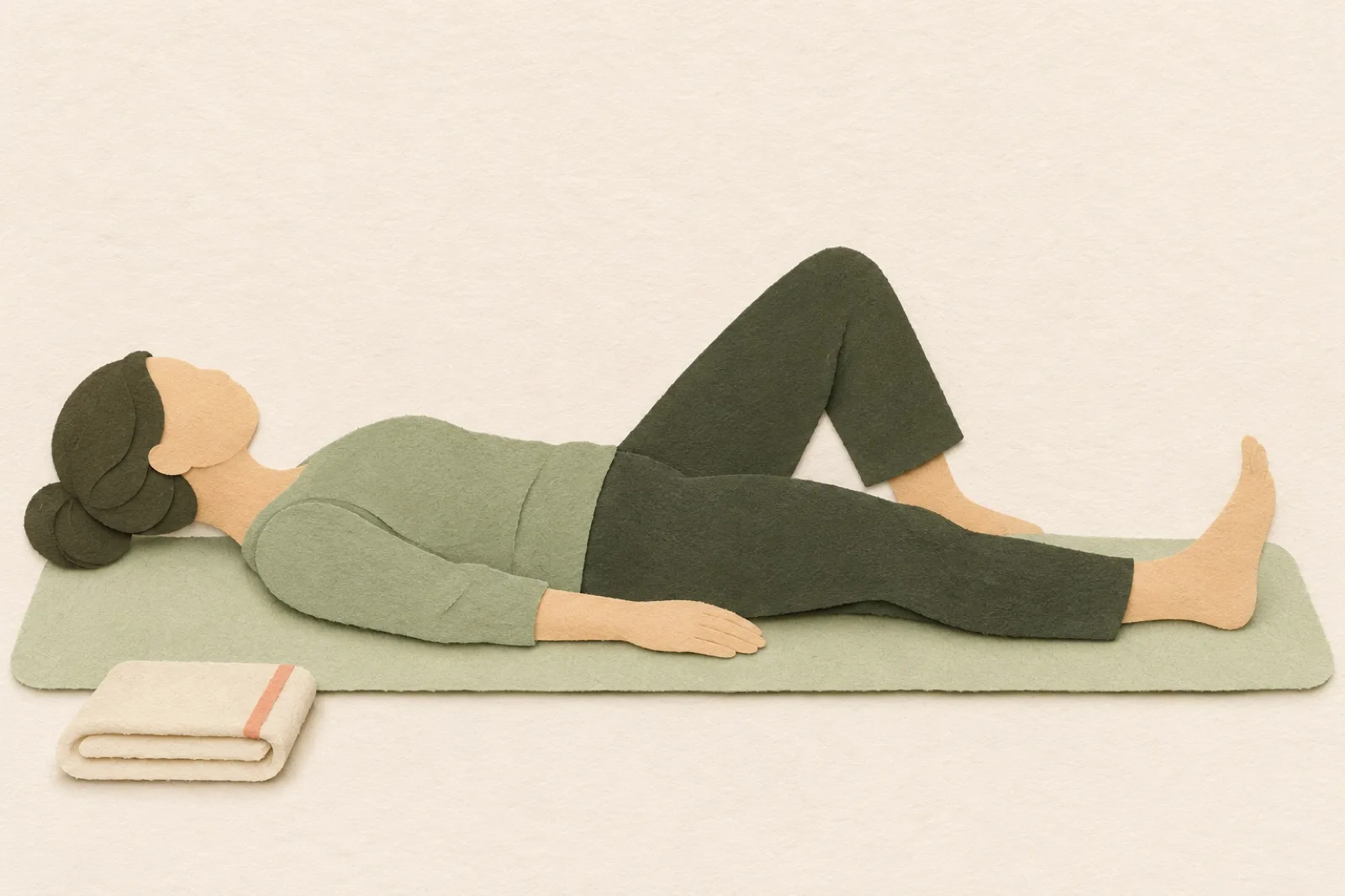
Try this: Lie on your back with knees bent and feet flat. Take a slow breath in. As you breathe out, gently engage your pelvic floor and lower belly, then slide your right heel away along the floor. Breathe in as you bring it back. Do a few on each side. Keep one hand on your belly and notice: does it stay calm, or does it dome or push up? If it pushes up, make the slide shorter. That's not a step backward. That's you learning where your foundation is today.
When can I do crunches again postpartum?
When the foundation is in place. When you can breathe through effort, your midline stays controlled, there's no leaking or heaviness, and your health professional agrees, curl-ups can be one useful tool among many. Not the goal. A tool.
The goal is a core that handles your real life: getting up from the floor, carrying a sleeping kid up the stairs, laughing without thinking twice. A different body, and it can be even stronger.
Key takeaways
- Crunches aren't "bad" and aren't forbidden forever, but for most moms they're usually not the first step after pregnancy.
- In a 2023 randomized trial, a 12-week home program with head lifts and curl-ups improved abdominal strength in women with abdominal separation, and their separation neither narrowed nor got worse.
- How you do a crunch may matter as much as which exercise you choose: in one study, gently engaging the deepest abdominal muscle first kept the midline tissue more taut.
- Your core is a team of the diaphragm, the pelvic floor and the deep abdominal muscles, and I teach that team to share pressure before adding load.
- A dome or a held breath is a cue to make the movement smaller or slower, while leaking, heaviness and pain mean stop that exercise and get assessed.
Frequently asked questions
Will crunches make my diastasis recti worse?
Not necessarily. A crunch narrows the gap between the two sides of the six-pack muscle in the moment, and a 2023 trial found curl-ups built strength without making separation worse. But another study suggests how you curl up affects how taut the midline tissue stays, and Cleveland Clinic advises against crunches when there is separation. The honest answer is individual, so get assessed first.
What core exercises can I start with after pregnancy?
Simple, attentive ones usually come first: breathing with deep core engagement, heel slides, glute bridges and modified side planks, done slowly with steady breathing. They teach your core the coordination every harder exercise will need later. These are examples, not a prescription. Get medical clearance from your doctor before you start, and ideally have a pelvic floor physical therapist take a look.
Why does my belly dome or cone when I do a crunch?
A dome is feedback that your diaphragm, pelvic floor and deep abdominal muscles may not be sharing the pressure of that effort evenly yet, though researchers are still working out exactly how pressure and these signs connect. It isn't failure: make the movement smaller, slow it down or exhale on the effort. If you also notice leaking, heaviness or pain, stop and get assessed.
Are planks okay after pregnancy?
Planks aren't off the table forever, but they're usually not where I'd begin. Cleveland Clinic advises against planks unless they're modified when there is abdominal separation, and against anything that makes your belly bulge, dome or cone. A modified side plank on your elbow, with knees bent and stacked and short holds, is one gentler option. Get medical clearance first, and stop if you notice pain, leaking that gets worse, heaviness or bleeding.
If you'd like someone to look at how your core manages pressure before you add load, that's exactly what my starter month is for. You can see how it works here, whenever you're ready.
My work is fitness coaching and does not replace medical or physical therapy care. Medical clearance from your doctor is required before starting. Individual results vary.
References
- Gluppe SB, Ellström Engh M, Bø K — Curl-up exercises improve abdominal muscle strength without worsening inter-recti distance in women with diastasis recti abdominis postpartum: a randomised controlled trial (Journal of Physiotherapy, 2023). https://pubmed.ncbi.nlm.nih.gov/37286390/
- Mota P, Pascoal AG, Carita AI, Bø K — The Immediate Effects on Inter-rectus Distance of Abdominal Crunch and Drawing-in Exercises During Pregnancy and the Postpartum Period (JOSPT, 2015). https://pubmed.ncbi.nlm.nih.gov/26304639/
- Lee D, Hodges PW — Behavior of the Linea Alba During a Curl-up Task in Diastasis Rectus Abdominis: An Observational Study (JOSPT, 2016). https://pubmed.ncbi.nlm.nih.gov/27363572/
- Goom T, Donnelly G, Brockwell E — Returning to running postnatal: guidelines for medical, health and fitness professionals managing this population (2019). https://athleticsni.org/download/files/Returning_to_running_postnatal_guideline_for_medical_health_and_fitness_professionals_managing_this_population.05.pdf
- Cleveland Clinic — Diastasis Recti. https://my.clevelandclinic.org/health/diseases/22346-diastasis-recti