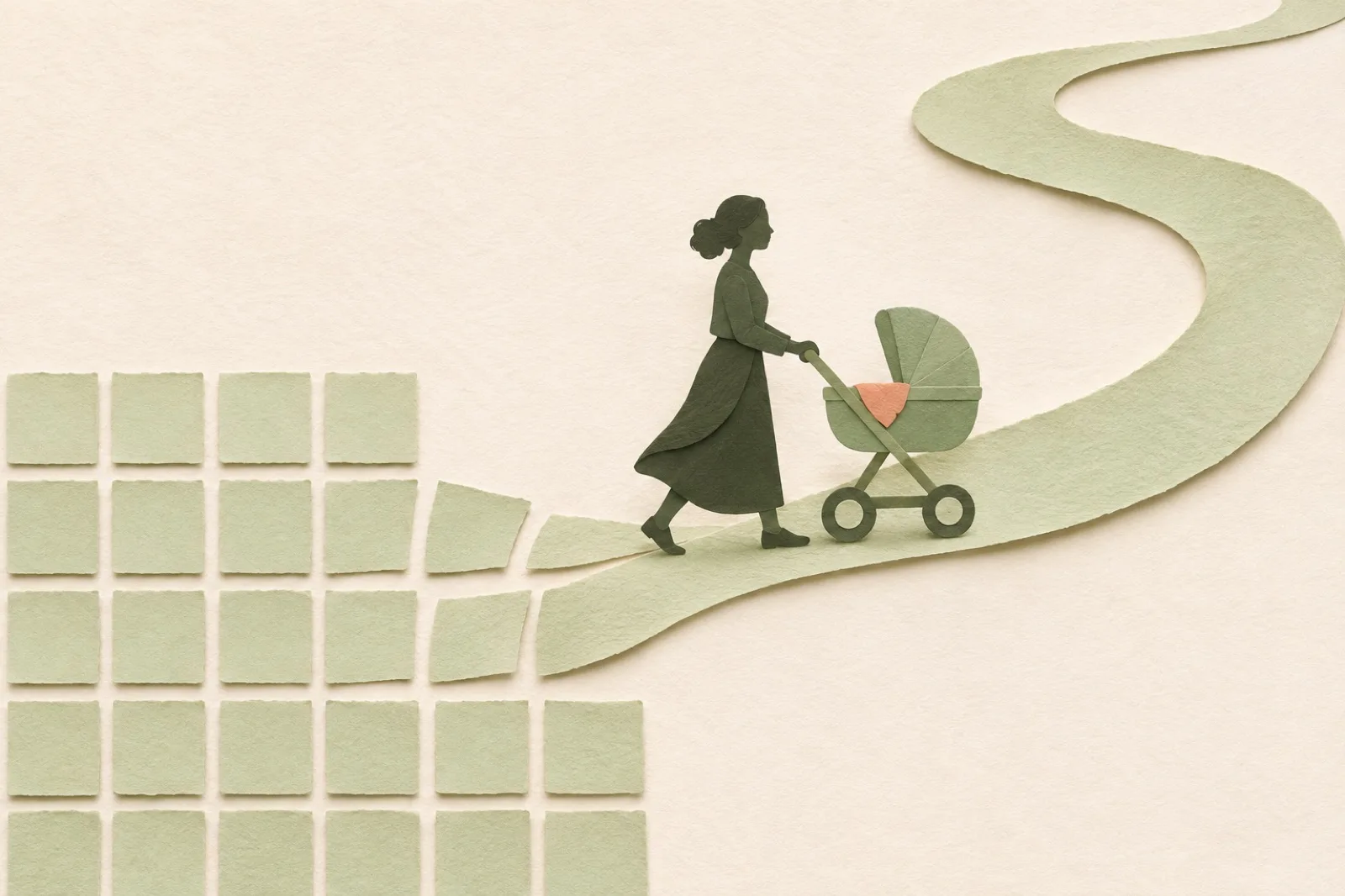
Somewhere along the way, most of us picked up the idea that six weeks after birth a door swings open. You go to your appointment, someone says "you're cleared," and you're supposed to go back to life as it was. Workouts, running, lifting, all of it.
I understand why that idea sticks. It gives a tired brain a date to hold on to. But after seven years working with pregnant and postpartum women, and two very different pregnancies of my own, I see that visit differently. It's a checkpoint. A starting point. Not a finish line.
The short answer: The six-week postpartum checkup is a starting point, not a finish line. Being cleared for exercise usually means there's no medical reason to keep you from moving more, not that your body is ready for running or heavy lifting right away. Get that clearance, consider an assessment with a pelvic floor physical therapist, and build back gradually.
The visit has changed, even if the myth hasn't
The American College of Obstetricians and Gynecologists (ACOG) describes postpartum care as an ongoing process rather than a single appointment. Its guidance recommends contact with your obstetric provider within the first 3 weeks after birth, follow-up care as needed, and a comprehensive postpartum visit no later than 12 weeks after birth.
That comprehensive visit is meant to cover a lot. Your mood and emotional well-being, sleep and fatigue, infant feeding, contraception, physical recovery from birth, and any chronic health conditions. That's a long list for one appointment, and it's exactly why I'd call it a check-in on many fronts, not a full readiness test for every kind of exercise.
What does "cleared for exercise" mean after giving birth?
When your doctor says you're cleared, that's important information. It usually means that, from what they looked at, there's no medical reason to keep you from moving more. Please get that clearance before you start a program. It matters.
Here's what it often doesn't mean:
- It doesn't necessarily mean anyone checked how your pelvic floor and deep core muscles are working together.
- It doesn't mean your body is ready for high impact, heavy lifting or long runs right away.
- It doesn't mean you should pick up exactly where you left off before pregnancy.
Think of it like getting your learner's permit. You're allowed on the road. You still start on quiet streets.

And it cuts the other way too. Gentle movement doesn't always have to wait for that visit. The NHS says that after a straightforward birth you can start gentle exercise, like walking, gentle stretches and pelvic floor exercises, as soon as you feel up to it, and that recovery takes longer after a more complicated birth or a cesarean. It also suggests getting advice at your postnatal check before starting high-impact exercise, such as aerobics or running. Ask your provider what makes sense for you and the birth you had.
Is a pelvic floor physical therapy assessment worth it after birth?
Pregnancy and birth ask a lot of your pelvic floor and your abdominal wall, whether you gave birth vaginally or by cesarean. A pelvic floor physical therapist is trained to assess how those muscles are doing: strength, coordination, how they respond to pressure, and how your abdominal wall handles load.
The 2019 return-to-running guideline written by physiotherapists Tom Goom, Gráinne Donnelly and Emma Brockwell recommends that every postnatal woman, however she gave birth, be offered a pelvic health assessment with a specialist physiotherapist from 6 weeks postnatal. In the US that isn't always part of routine care, so you may need to ask your doctor for a referral.
I don't replace your doctor or your physical therapist. I walk with you after them, until you don't need me anymore. Their assessment gives us a map. Without it, we're guessing.
When can I start running after having a baby?
Foundation before load. It's one of the principles I build everything on, and it matters most right here.
A gradual return often looks something like this: breathing and reconnecting with your deep core and pelvic floor, walking, low-impact strength work, and then slowly adding load and intensity as your body shows you it's handling what you already do.
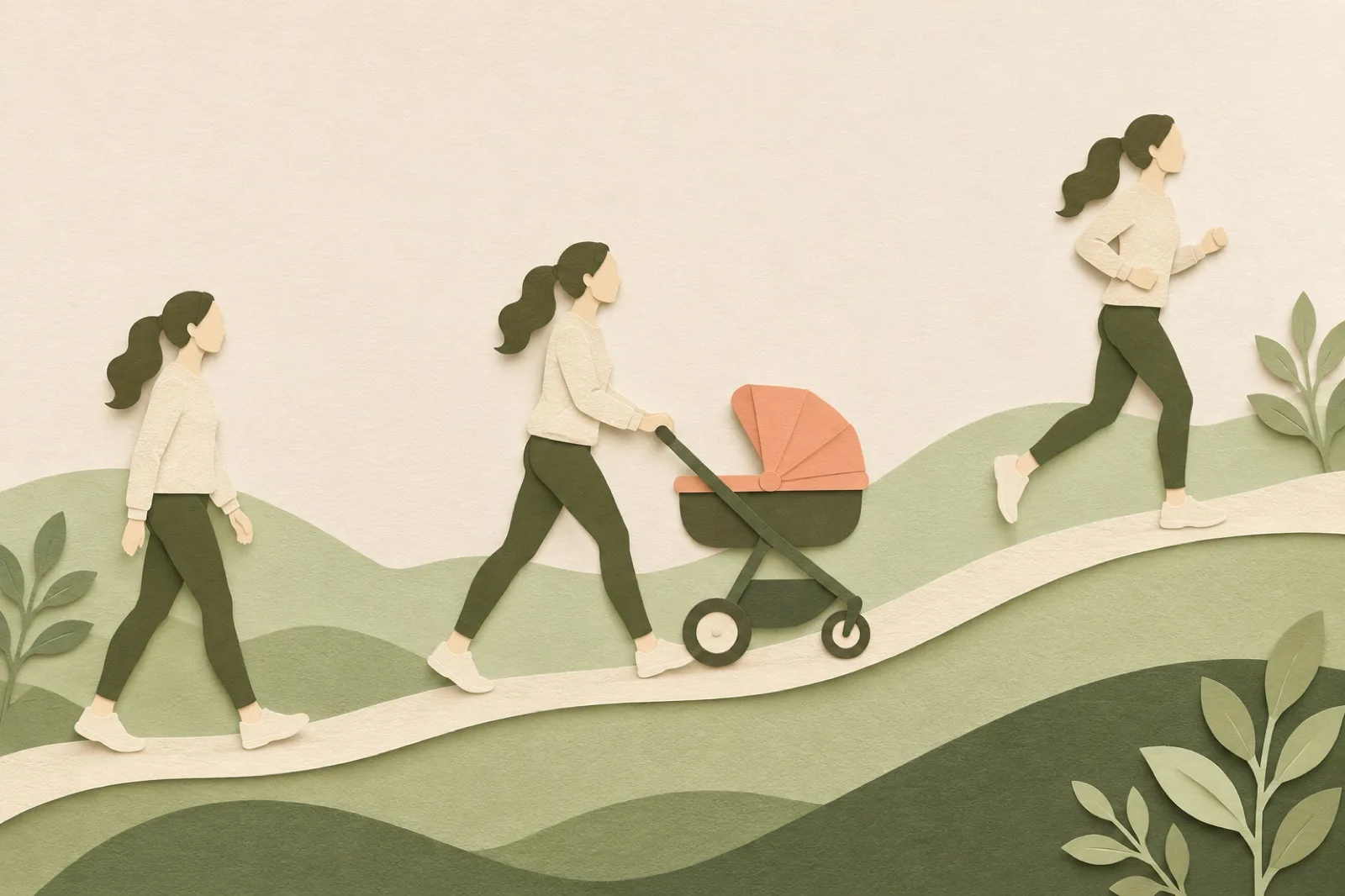
Running and other high-impact activities usually come later. The Goom, Donnelly and Brockwell guideline suggests a low-impact plan for the first 3 months, followed by a return to running between 3 and 6 months postnatal at the earliest. It also says running isn't advisable before 3 months, or after that point for as long as there are symptoms of pelvic floor dysfunction. The authors are open that the evidence here is limited and that this part rests on expert opinion. It's guidance written for professionals to reason with, not a date stamped on your calendar.
The guideline also lists simple tests a professional can use to check readiness for impact: walking for 30 minutes, balancing on one leg, single-leg squats, jogging on the spot, hopping and bounding, all without pain, heaviness, dragging or leaking. That isn't a home exam to pass or fail. It's a useful picture of what "ready" really asks of your body: strength, balance and a pelvic floor that can handle repeated impact.
Signs to pause
Whatever stage you're in, your body gives you feedback. Stop and talk to your doctor or pelvic floor physical therapist if you notice:
- Pain during or after exercise, including pelvic or lower back pain
- Leaking urine or stool, or leaking that gets worse
- A feeling of heaviness, pressure, dragging or bulging in the vagina
- Bleeding that comes back or increases with activity
- A noticeable bulge along the middle of your belly when you exert yourself
Pausing isn't failing. It's information. Often it just means changing the exercise, the load or the timing.
Try this: After your next walk, sit down for two quiet minutes. Put your hands on the sides of your ribs. Breathe in through your nose and let your ribs widen into your hands. Breathe out slowly and notice a gentle lift and wrap through your lower belly and pelvic floor. Repeat five times. Then check in: any heaviness, leaking or pain during or after the walk? If everything felt fine, that walk is your current baseline, and next time you can add a few minutes. If you had a cesarean or a complicated birth, follow your provider's timeline for walking first. If something didn't feel right, scale back and talk to your doctor or pelvic floor PT before you add more.
Recovery isn't only about exercise
Sleep, feeding and stress are part of the picture too. The return-to-running guideline names sleep as key for recovery from both physical and psychological stress, and notes that sleep loss is thought to reduce muscle strength. It also asks professionals to consider breastfeeding, emotional well-being and whether a mom is eating enough for everything her body is doing.
So if you're up several times a night, feeding a baby and running on coffee, your body is already working hard. That's not a reason to do nothing. It's a reason to be smart about it: shorter sessions, more patience, real meals, and rest when you can get it. And if your mood feels heavy, tell your provider. If you ever have thoughts of hurting yourself or your baby, call 911 or call or text 988 right away. ACOG lists mood and emotional well-being as part of postpartum care, and it deserves as much attention as your muscles.
Since you became a mom, you're living in a different body. With time and the right foundation, it can be even stronger.
Key takeaways
- The six-week postpartum checkup is a checkpoint and a starting point, not a finish line for your recovery.
- ACOG describes postpartum care as an ongoing process, with a comprehensive visit no later than 12 weeks after birth.
- Being cleared for exercise means you can start moving more, not that you're ready for high impact or heavy lifting.
- A 2019 return-to-running guideline, based on expert opinion, suggests offering every postnatal woman a pelvic health assessment from 6 weeks and running between 3 and 6 months at the earliest.
- Pain, leaking, heaviness or bulging in the vagina, or bleeding are signs to pause and talk to your doctor or pelvic floor physical therapist.
Frequently asked questions
Can I exercise before my six-week postpartum checkup?
Gentle exercise often doesn't have to wait for that visit. The NHS says that after a straightforward birth you can start walking, gentle stretches and pelvic floor exercises as soon as you feel up to it, and that recovery takes longer after a complicated birth or a cesarean. Get advice before high-impact exercise like running, and stop if you notice pain, leaking, heaviness or bleeding.
Does my doctor check my pelvic floor at the postpartum visit?
Not necessarily in the detailed way a specialist would. The postpartum visit covers a lot, from mood and sleep to feeding and physical recovery, so being cleared doesn't always mean anyone checked how your pelvic floor and deep core work together. A pelvic floor physical therapist is trained to assess that. In the US this isn't always part of routine care, so you may need to ask your doctor for a referral.
How do I know if my body is ready for running after pregnancy?
A professional is the best person to help you decide, ideally a pelvic floor physical therapist. The 2019 return-to-running guideline lists simple tests they can use, like walking for 30 minutes, balancing on one leg, single-leg squats, jogging on the spot and hopping, all without pain, heaviness, dragging or leaking. It isn't a home exam to pass or fail. The authors are open that this guidance rests on expert opinion and limited evidence.
Does lack of sleep affect postpartum recovery?
Yes, it's part of the picture. The return-to-running guideline names sleep as key for recovery from physical and psychological stress, and notes that sleep loss is thought to reduce muscle strength. That's a reason to keep sessions shorter, eat real meals and rest when you can. If your mood feels heavy, tell your provider, because emotional well-being is part of postpartum care too.
If you're past that checkup and still not sure where to start, I'd love to help you figure it out. My starter month begins with an individual assessment, so we build from where your body actually is today. You can read about it here.
My work is fitness coaching and does not replace medical or physical therapy care. Medical clearance from your doctor is required before starting. Individual results vary.
References
- American College of Obstetricians and Gynecologists — ACOG Committee Opinion No. 736: Optimizing Postpartum Care (Obstet Gynecol, 2018). https://pubmed.ncbi.nlm.nih.gov/29683911/
- Goom T, Donnelly G, Brockwell E — Returning to running postnatal: guidelines for medical, health and fitness professionals managing this population (March 2019). https://athleticsni.org/download/files/Returning_to_running_postnatal_guideline_for_medical_health_and_fitness_professionals_managing_this_population.05.pdf
- NHS — Keeping fit and healthy with a baby. https://www.nhs.uk/conditions/baby/support-and-services/keeping-fit-and-healthy-with-a-baby/