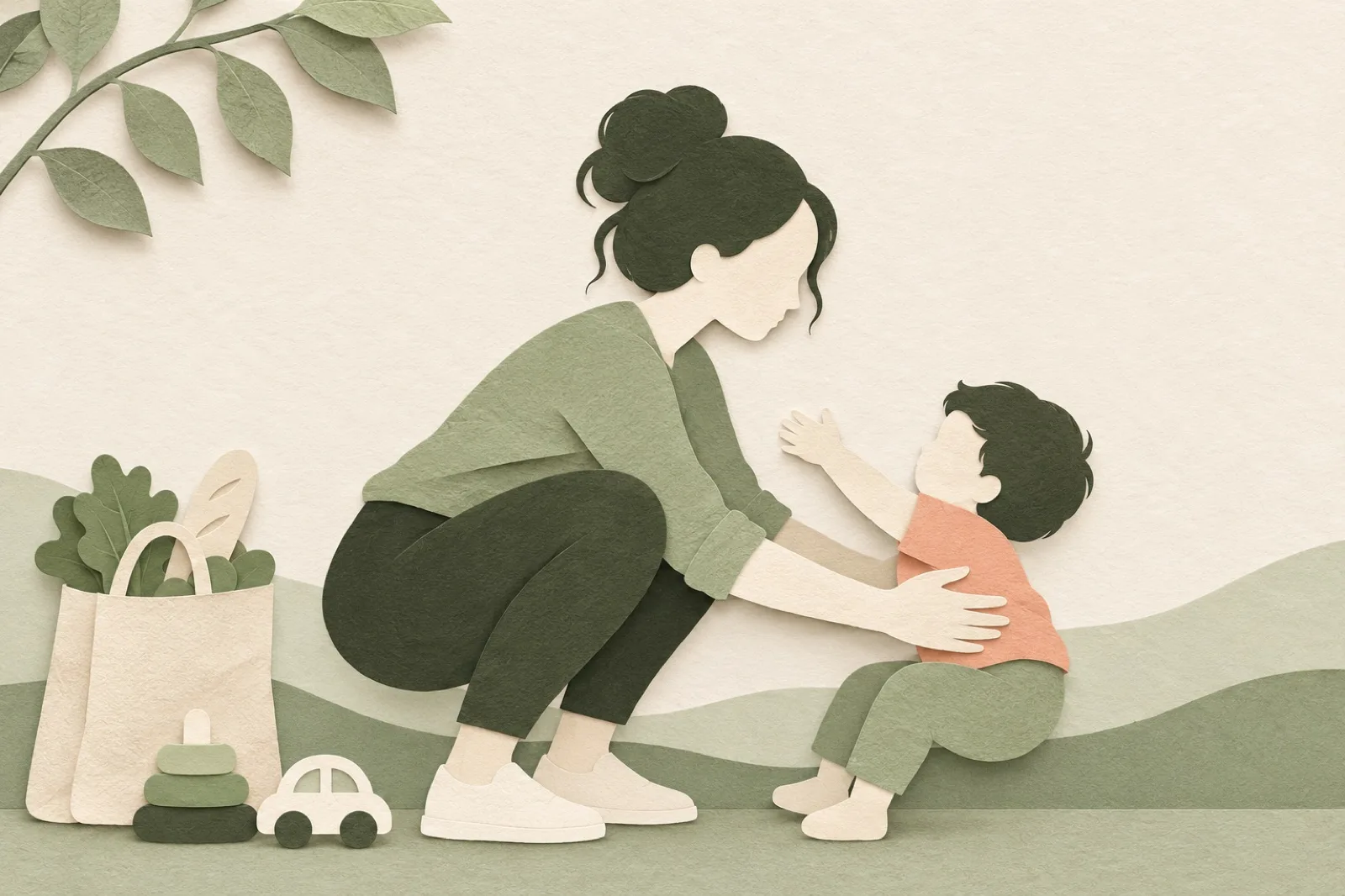
Let's talk about the strength nobody posts about.
Not the arms in a tank top. The strength it takes to scoop a toddler off the floor with one arm. To get down on the rug for a puzzle and get back up without a groan. To push a stroller up the hill at the park with a backpack full of snacks on your shoulders.
That's the training I care about. Because that's the life you're actually living.
The short answer: Strength training for moms works best when it trains the movements your day already asks for: squatting, hinging, carrying, pushing, pulling and getting up from the floor. I build it foundation first, with your breath and pelvic floor working together, and then add load gradually. Get medical clearance before you start, and consider an assessment with a pelvic floor physical therapist.
The real test isn't the mirror
Most fitness messaging for moms is about how you look. I get why. But looks are a shaky way to measure progress, and they tell you almost nothing about how your body handles your day.
So I measure differently. Can you squat down to the floor to pick up a toy and stand back up feeling steady? Can you lift the car seat out of the car without that twinge in your back? Can you carry a kid on one hip and the bag on the other across a parking lot? Can you get up from the floor more easily than you could a few months ago?
Those are real answers. And they're things you can train for.
What strength exercises help with everyday mom life?
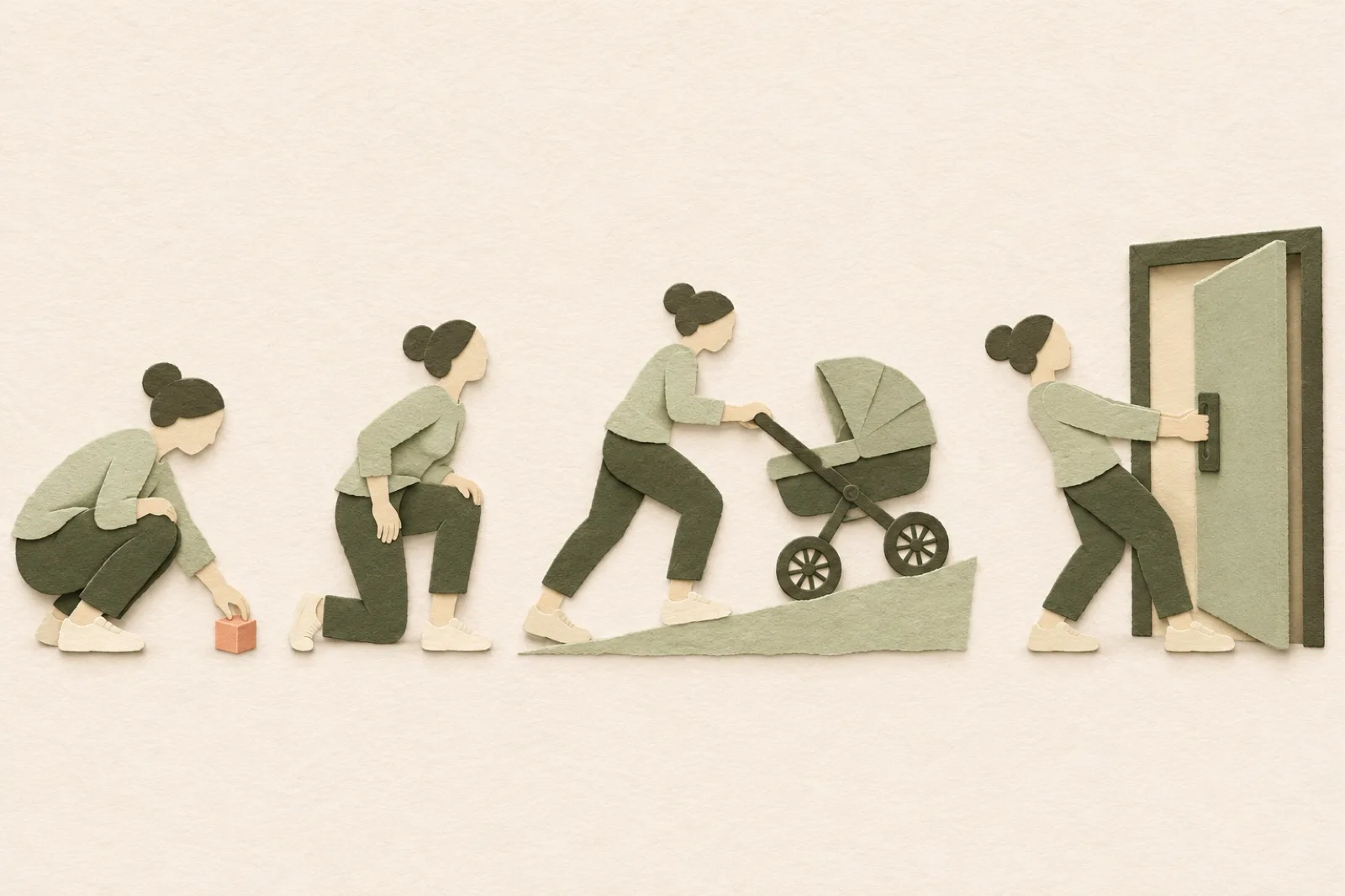
When I look at a mom's typical day, I see the same handful of movement patterns again and again. These are the foundation of the strength phase in my work:
- Squat: getting down to the floor for bath time, picking up toys, sitting on that tiny chair at the school event.
- Hinge: bending at the hips to lift a laundry basket or reach into the crib, with your back long instead of rounded.
- Carry: a kid on one hip, a grocery bag in the other hand, a diaper bag over the shoulder. Usually all at once. (Carrying in front and switching sides is easier on your body, and we practice that too.)
- Push: the stroller uphill, a heavy door with your hip, a shopping cart that has a mind of its own.
- Pull: opening the car door, dragging the stroller out of the trunk, holding on to a kid who suddenly wants to go the other way.
- Get up from the floor: after playing, after stretching, after you sat down "just for a minute" in the middle of the toys.
The US Physical Activity Guidelines recommend that adults do muscle-strengthening activities that work all the major muscle groups on 2 or more days a week. Training these patterns is a practical way to do that, because every rep looks like something you'll actually use.
How are my core, pelvic floor and back connected?
Here's one anatomy idea worth knowing. Your deep core works like a canister. The diaphragm sits on top, the pelvic floor at the bottom, and the deep abdominal and back muscles wrap around the sides. Every time you lift, carry or push, pressure inside that canister goes up. The goal is a core that can manage that pressure, not one that just braces as hard as it can.
There's lab research behind the idea that this system works as a team. A small study by Hodges and colleagues found that the pelvic floor muscles switched on just before arm movements that challenge the stability of the spine, and that they were also active during breathing. In plain language: your pelvic floor, your breath and your posture are connected.
What does that mean for your back? Many moms notice their back when they lift, carry or bend over and over all day. Strong hips and back muscles, plus a core that coordinates with your breath, may help everyday tasks feel more comfortable for some people. UK guidelines on low back pain from NICE suggest considering a group exercise program for people with an episode of low back pain. I can't promise any result, and back pain has many possible causes. If you have pain, see your doctor or physical therapist first, so we know what we're working with.
How should strength training progress after pregnancy?
I don't hand a heavy kettlebell to someone who hasn't yet found her breath and her pelvic floor. Foundation before load is a principle I don't skip.
In practice, progression usually looks like this:
- Reconnect: breathing, rib and pelvis alignment, and coordination between your core and pelvic floor.
- Pattern: learn each movement with body weight or very light load, focusing on how it feels.
- Load: add weight, reps or range gradually, as long as your body keeps handling it well.
- Real life: combine patterns the way your day does, like lifting and then carrying, or squatting and then standing up with weight.
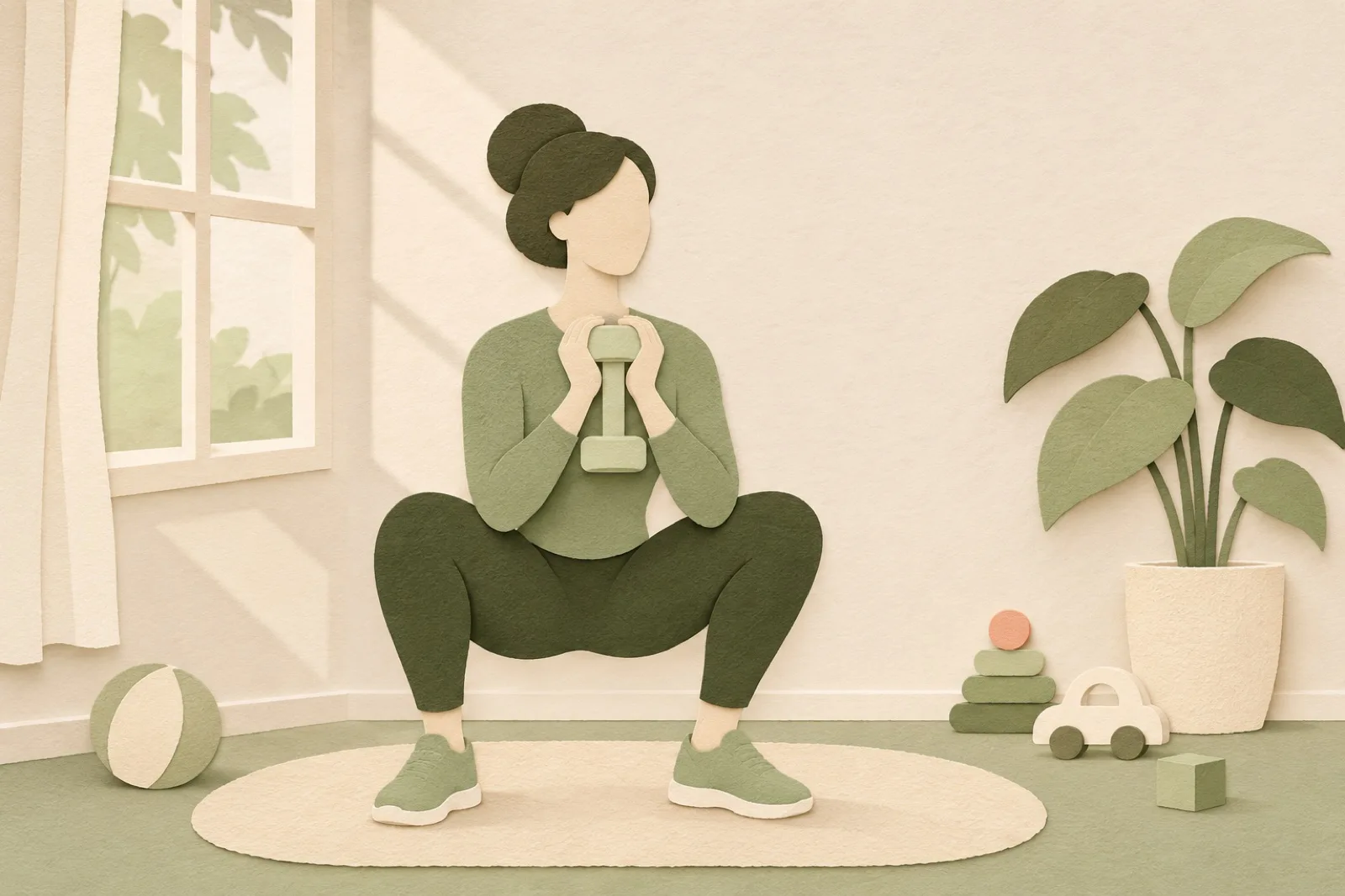
The pace is individual. For some women the early stages go quickly. Others need more time, especially when sleep is short. Both are fine. Moving on before you're ready rarely saves time.
A different body, and it can be even stronger
Since you became a mom, your body has changed. I'm not going to pretend it hasn't, and I don't think you need it to go back.
I work with moms of babies and moms whose kids are already teenagers, and the principle is the same for both: it's never too late to get stronger for the life you have now.
Try this: Floor to standing, with support. Kneel on a mat next to a sturdy chair or couch. Breathe in through your nose and let your ribs widen. As you breathe out, bring one foot forward into a half-kneeling position and feel a gentle lift and wrap through your lower belly and pelvic floor. Place a hand on the chair. Breathe in to prepare, then breathe out as you press through your front foot and stand up. Step back down slowly to kneeling, then sit to the side. Do 3 to 5 times on each side. Over the weeks, use your hand a little less. Don't hold your breath, and don't rush. Stop and talk to a health professional if you feel pain, leaking that gets worse, heaviness or bulging in the vagina, or any bleeding.
Before starting any new routine, get clearance from your doctor, and consider an assessment with a pelvic floor physical therapist, especially if you notice any of the signs above.
Key takeaways
- Real-life strength for moms means being able to squat, hinge, carry, push, pull and get up from the floor feeling steady.
- The US Physical Activity Guidelines recommend muscle-strengthening activities that work all the major muscle groups on 2 or more days a week.
- Your deep core works like a canister, with the diaphragm on top and the pelvic floor at the bottom, and the goal is a core that manages pressure rather than one that just braces as hard as it can.
- Foundation comes before load: reconnect with your breath and pelvic floor, learn each pattern with light load, then add weight gradually.
- It's never too late to get stronger for the life you have now, whether your kids are babies or teenagers.
Frequently asked questions
Is it too late to get stronger if my kids are already teenagers?
No, it's never too late to get stronger for the life you have now. I work with moms of babies and moms whose kids are already teenagers, and the principle is the same: start with your breath and pelvic floor, learn the patterns your day asks for, then add load gradually. The pace is individual. Get medical clearance first, and consider an assessment with a pelvic floor physical therapist.
How often should moms do strength training?
The US Physical Activity Guidelines recommend that adults do muscle-strengthening activities that work all the major muscle groups on 2 or more days a week. Training everyday patterns like squatting, hinging, carrying, pushing and pulling is a practical way to meet that, because every rep looks like something you'll use. Get clearance from your doctor before starting, and stop if you notice pain, leaking that gets worse, heaviness or bleeding.
Can strength training help with back pain from carrying my kids?
It may help everyday tasks feel more comfortable for some people, but I can't promise any result. Strong hips and back muscles, plus a core that coordinates with your breath, are part of how I train lifting and carrying. UK guidelines from NICE suggest considering a group exercise program for an episode of low back pain. Back pain has many possible causes, so if you have pain, see your doctor or physical therapist first.
Should I brace my core as hard as I can when I lift my baby?
Not as hard as you can. Your deep core works like a canister, and pressure inside it goes up every time you lift, carry or push. The goal is a core that manages that pressure, not one that just braces with everything it has. In practice, that means not holding your breath and breathing out as you make the effort. If lifting brings pain, leaking or heaviness in the vagina, pause and talk to a health professional.
If training for real life sounds like what you've been missing, that's the heart of what I do in ReConnect Mom. We start with an assessment, build the foundation, and then get you strong for your actual day. You can read how ReConnect Mom works.
My work is fitness coaching and does not replace medical or physical therapy care. Medical clearance from your doctor is required before starting. Individual results vary.
References
- U.S. Department of Health and Human Services — Physical Activity Guidelines for Americans, 2nd edition (2018). https://odphp.health.gov/sites/default/files/2019-09/Physical_Activity_Guidelines_2nd_edition.pdf
- Hodges PW, Sapsford R, Pengel LH — Postural and respiratory functions of the pelvic floor muscles. Neurourology and Urodynamics, 2007. https://pubmed.ncbi.nlm.nih.gov/17304528/
- National Institute for Health and Care Excellence (NICE) — Low back pain and sciatica in over 16s: assessment and management (NG59). https://www.nice.org.uk/guidance/ng59/chapter/Recommendations