If you've ever typed "diastasis recti" into your phone at 2 a.m. while the baby finally slept, you probably closed the screen more scared than when you opened it. Photos of bellies. Finger measurements. Words like "damage."
Let me take some of that weight off your shoulders.
Abdominal separation is one of the most common things that happens to a body that has carried a baby. It's worth understanding. It isn't worth panicking over. And since I'm an anatomy teacher at heart, let's start with what's actually in there.
The short answer: Abdominal separation (diastasis recti) is one of the most common things that happens in and after pregnancy. The two sides of your six-pack muscle move apart as the linea alba, the connective tissue between them, stretches to make room for your baby. How well your midline holds tension matters, not only a number, so get assessed by a pelvic floor physical therapist or your doctor.
What is diastasis recti, and why does the linea alba stretch?
Your "six-pack" muscle, the rectus abdominis, isn't one solid sheet. It's two long bands running down the front of your belly, one on each side. Between them sits the linea alba, a strip of connective tissue that joins the left and right halves.
Here's the part most people never hear: the linea alba isn't just a gap filler. The deeper layers of your core, the muscles that wrap around your waist like a corset, send their sheaths toward the middle and meet there. So the midline is where the whole fabric of your abdominal wall is stitched together. When those layers work, they pull on that seam from both sides and give it tension.
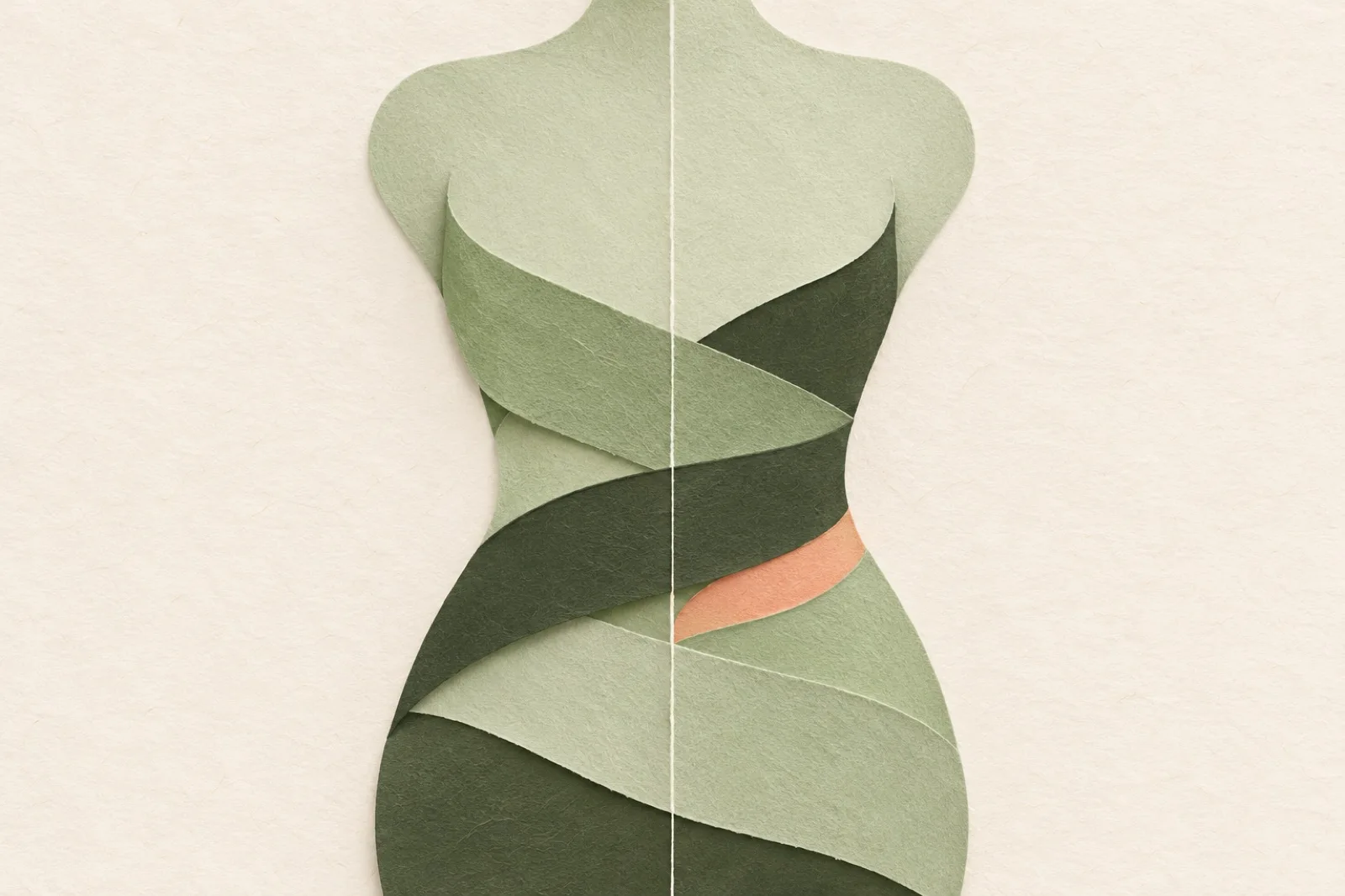
That seam is elastic, and it's designed to give. As your uterus grows, it pushes the two sides of the rectus apart and the muscles get longer. The linea alba stretches to make room. Cleveland Clinic compares it to a rubber band: it's elastic, but it can lose some of that elasticity from being stretched, which is one reason the midline can feel different afterward.
How common is abdominal separation in pregnancy?
This surprises a lot of moms: separation during pregnancy isn't a sign that something went wrong. It's part of how a belly makes room for a baby.
In one ultrasound study that followed 84 first-time moms, every one of them met the study's definition of separation by week 35 of pregnancy. Six months after birth, more than a third still did. That's a lot of moms walking around with a midline that's still finding its tension, most of them without anyone ever explaining it.
So if you have some separation, you're in very big company. It's common, but it's not something you have to live with, and it's not something to be scared of.
And this isn't only a new-baby topic. I work with many moms whose kids are already teenagers. It's never too late to start understanding your core.
From "how wide is the gap" to "how well does it hold"
For a long time, the conversation was mostly about width. How many fingers fit? How many centimeters? Width still matters, and professionals do measure it. But researchers and pelvic health physical therapists are paying more attention to a second question: how well does your midline handle tension and load?
One study I find really interesting looked at the linea alba on ultrasound while women with separation did a curl-up. When they curled up on autopilot, the gap got narrower, but the tissue between the muscles sagged and distorted more. When they gently engaged their deepest abdominal muscle first, the gap narrowed less, and the tissue stayed more taut. The authors are careful to say their measure of distortion still needs more validation, so this isn't the final word. But the idea is important: a narrower gap doesn't automatically mean a better-working midline.
Think of a tent. What matters isn't only how far apart the poles are. It's whether the fabric between them is taut enough to hold its shape when the wind pushes on it.

The 2019 return-to-running guideline written by pelvic health physiotherapists uses language I love here. It describes a separation that is "functional": the separation is present, but the mom has strategies to manage the pressure inside her belly and transfer load across her abdominal wall. That's why I don't talk about closing anything. I talk about tension, function, and building strength from your core.
What to notice in your own body
You don't need a tape measure to start paying attention. Next time you make an effort, like sitting up, lifting your toddler, coughing or carrying groceries, glance at your belly and notice:
- A ridge, dome or cone shape popping up along the middle
- A soft dip that sinks in along the midline during effort
- A soft, squishy feeling around your belly button
- A feeling that your belly "doesn't hold" when you lift something
These are clues, not verdicts. Noticing is not the same as knowing what's going on, and seeing a dome once doesn't mean you have a problem. It just means your body is giving you information worth sharing with a professional. One exception to the no-rush tone: a lump or bulge near your belly button or along your midline that stays out when you relax, or that hurts, is something to show your doctor soon instead of watching it at home.
Can I check for diastasis recti at home?
Online you'll find finger tests and charts that tell you what your number "means." I understand the pull. When you're worried, you want an answer.
But a number you measured yourself, lying on the bedroom floor, can't tell you how your midline behaves under load. It can't tell you how your breathing and your pelvic floor are working together, or what your body needs next. The return-to-running guideline recommends that separation be screened by a suitably qualified professional, such as a pelvic health physical therapist with experience in this area, and it suggests every mom get a pelvic health assessment after birth, however she delivered.
A pelvic floor physical therapist or your doctor can look at width and tension together and give you a real picture. Then you can build from there with a plan that fits your body, not a stranger's chart.

I don't replace your doctor or your physical therapist. I walk with you after them, until you don't need me anymore.
What I can promise is honesty: I won't promise to change your measurements. What we work on together is a core that handles your real life, lifting, carrying, getting up off the floor, with more confidence. A different body, and it can be even stronger.
One small thing to try this week
Getting up from lying down is one of the most repeated "core exercises" of your day, and most of us do it with a straight sit-up without thinking.
Try this: The next time you get up from lying on your back, out of bed or off the floor after playing with your kids, skip the sit-up. Bend your knees, roll onto your side as one piece, and use your arms to push yourself up to sitting. Before you roll, take an easy breath in, and as you breathe out, let your lower belly gently draw in. Then notice: does your belly stay calmer when you roll than when you sit straight up? You're not testing yourself. You're just getting curious about what your midline does.
Please check with your doctor before starting any exercise. And if anything you try brings pain, leaking that gets worse, a feeling of heaviness or bulging in the vagina, or bleeding, stop and talk to your doctor or a pelvic floor physical therapist.
Key takeaways
- Abdominal separation (diastasis recti) happens when the linea alba, the tissue joining the two sides of your six-pack muscle, stretches as your uterus grows.
- Some separation during pregnancy is expected: in one ultrasound study, all 84 first-time moms met the study's definition by week 35.
- Width is only part of the picture, because how well your midline holds tension and handles load matters too.
- A pelvic floor physical therapist or your doctor can assess width and tension together, which a self-check at home can't do.
Frequently asked questions
Is it too late to work on abdominal separation 10 years after having kids?
No. It's never too late to start understanding your core, and I work with many moms whose kids are already teenagers. Start with medical clearance from your doctor and an assessment with a pelvic floor physical therapist, who can look at width and tension together. From there, we build strength from your core for the life you have now.
Will exercise make abdominal separation go away?
I won't promise that any exercise will change your measurements, and I don't talk about closing anything. The 2019 return-to-running guideline calls a separation "functional" when it is present but you have strategies to manage the pressure inside your belly and transfer load across your abdominal wall. That's what I work toward: tension, function and strength.
What does doming or coning along the middle of my belly mean?
A dome, cone or ridge along your midline when you sit up, lift or cough is a clue worth sharing with a pelvic floor physical therapist or your doctor, not a verdict. Seeing it once doesn't mean something is wrong. One exception: a lump or bulge near your belly button that stays out when you relax, or that hurts, is something to show your doctor soon.
Is there a gentler way to get out of bed with abdominal separation?
Yes. Instead of a straight sit-up, bend your knees, roll onto your side as one piece and push yourself up to sitting with your arms, as Cleveland Clinic suggests. Check with your doctor before starting any exercise, and stop if anything brings pain, leaking that gets worse, heaviness or bleeding.
I had two very different pregnancies myself. If you'd like a gentle first look at how you're doing right now, not with your gap but with your body as a whole, I made a 2-minute quiz for you: How at home do you feel in your body? No tape measure required.
My work is fitness coaching and does not replace medical or physical therapy care. Medical clearance from your doctor is required before starting. Individual results vary.
References
- Cleveland Clinic — Diastasis Recti. https://my.clevelandclinic.org/health/diseases/22346-diastasis-recti
- NHS — Your post-pregnancy body. https://www.nhs.uk/conditions/baby/support-and-services/your-post-pregnancy-body/
- Fernandes da Mota PG, Pascoal AG, Carita AI, Bø K — Prevalence and risk factors of diastasis recti abdominis from late pregnancy to 6 months postpartum, and relationship with lumbo-pelvic pain (Manual Therapy, 2015). https://pubmed.ncbi.nlm.nih.gov/25282439/
- Lee D, Hodges PW — Behavior of the Linea Alba During a Curl-up Task in Diastasis Rectus Abdominis: An Observational Study (JOSPT, 2016). https://pubmed.ncbi.nlm.nih.gov/27363572/
- Goom T, Donnelly G, Brockwell E — Returning to running postnatal: guidelines for medical, health and fitness professionals managing this population (2019). https://athleticsni.org/download/files/Returning_to_running_postnatal_guideline_for_medical_health_and_fitness_professionals_managing_this_population.05.pdf